 Practice start-up and takeover
 Visibility
 Ideal patients
 Staff
 Clarity
Server-side conversion tracking for medical practicesKnow which channel brings which enquiry, instead of guessing.
For practices that invest in marketing and want to know which part of it brings appointments: calls, forms and appointment bookings are attributed to their source, with consent and without health data.

For a practice, tracking means attributing every enquiry to its origin: did the call come via the website, the form via an ad, the appointment booking via the Google profile? It is set up as server-side tracking, runs with consent and counts enquiries, not people. What it doesn't do: record treatment data or follow visitors around the web.
More terms explained in the glossary- Price
- from €320 per month; reporting is included free of charge with every service
- Time to results
- set-up in 1 to 2 weeks, reliable figures after 3 months
- What you contribute
- access to your website, Google profile and ad accounts, plus a short meeting on your consent solution
Where practices stand today
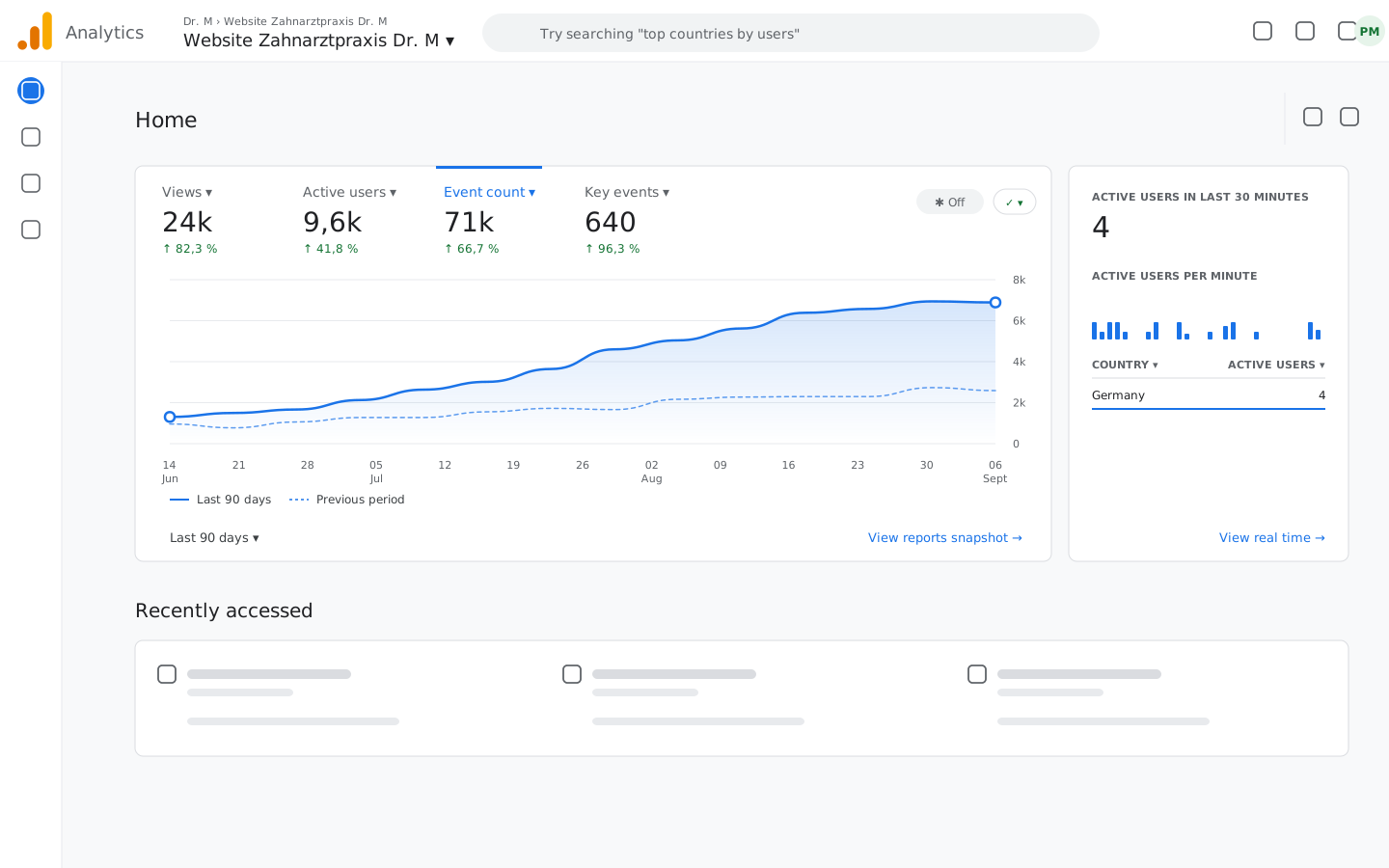
An enquiry comes in and nobody knows where from. So every activity keeps running because it might have been the one, and the budget gets spread by gut feeling. Yet where enquiries come from is exactly what should decide which activity stays and which goes.
What we do differently
We count what counts: calls via the website, forms and appointment bookings, per channel and per ad. Server-side, so it runs reliably; with consent, so it meets data protection requirements; and without health data. The result is one figure per channel: enquiries and cost per enquiry.
When you don't need tracking
To be honest, there are cases where the money goes up in smoke. Then something else comes first.
Only one activity is running and you know that's where the enquiries come from.
Then the reporting for that activity is enough. Tracking pays off as soon as two channels are running.
First: Reporting →Your website is outdated and has no clear path for enquiries.
There's nothing to measure if enquiries end up nowhere. Website first.
First: Website and web design →You want to know which person is looking for which treatment.
We don't record that, because it would be health data. We count enquiries and their origin, not people.
How it works
- 01
Audit: which channels are running, where enquiries arrive, which consent solution is in place
Week 1
- 02
Set-up: server-side tracking, counting calls and forms, connecting ad accounts
Weeks 1 to 2
- 03
Testing: test enquiries per channel, data protection check, handover into the monthly report
Week 2
- 04
Ongoing: figures per channel in the monthly report, and after three months the first decision on what stays and what goes
monthly
Automated: counting, attribution and the monthly report run automatically, without anyone maintaining spreadsheets.
Human: we decide with you what should and shouldn't be measured. And the decision on which activity goes remains yours, backed by our figures.
What AI changes
With AI Overviews and AI Mode on Google (in Germany since March and October 2025), the sources of your visits are shifting: an Ahrefs study from February 2026 measures on average 58 per cent fewer clicks on the first result when an AI Overview appears. If you don't count visits from ChatGPT, Perplexity and Google's AI separately, you won't see this shift. That's why AI sources get their own channel in our tracking.
Last checked: October 2026
What comes before, what comes after
Tracking comes in as soon as two channels are running, and before any decision to stop an activity. Before that, you need a website with a clear path for enquiries. After that: reporting that puts the figures into context every month. Reporting is always included.
Reporting is always included with us, not an extra.
FAQs on server-side tracking for practices
Is tracking compatible with the GDPR?
Yes, if it runs with consent, is set up server-side and doesn't record health data. We set up the consent solution with you and document what is counted. Your data protection officer or lawyer handles the legal review in individual cases; we deliver a clean foundation.
Do you record health data?
No. We count enquiries and their origin: call, form, appointment booking, channel. This matters because even visiting a page about a specific treatment can reveal something about a person's health: in 2023 the Court of Justice of the European Union ruled that merely viewing such pages can reveal specially protected data under Art. 9 GDPR (Case C-252/21). That's why our pages about individual treatments don't pass any information to advertising platforms.
How do you count calls?
Via the call button on the website and, if you wish, via separate phone numbers for each channel. This shows whether a call came from an ad, from search or from your Google profile.
What is server-side tracking?
Counting runs via your own server instead of via scripts in the visitor's browser. This is more reliable because ad blockers and browser settings affect it less, and it can be cleanly linked to consent.
How quickly will I have figures?
Set-up takes one to two weeks, after which every month gives you a clearer picture. After three months the data is solid enough to stop or expand activities.
What does tracking cost?
Tracking starts at €320 per month, depending on how many channels and ad accounts are connected. Reporting is free and included with every service.
How do you measure enquiries from ChatGPT and Google's AI Overviews?
Visits from ChatGPT, Perplexity, Gemini and Copilot get their own channel in the analysis so they don't disappear under “referrals”. Google Search Console doesn't report clicks from AI Overviews separately, so a fixed list of patient questions checked every month helps there. And we recommend the simplest measurement of all: asking in the form and on the phone how the patient found the practice, with “ChatGPT or another AI” as a separate answer option.
Do you also count online appointment bookings via Doctolib, Dr. Flex or other tools?
Yes. We count a click on the booking button as an enquiry, just like a call or a form, and attribute it to its source. Whether the completed booking in the third-party tool can also be counted depends on the provider; we check this during the audit.

Do you know where your enquiries come from?
In a free initial call we look at which channels are running and what can already be counted today.
Free · No obligation