 Practice start-up and takeover
 Visibility
 Ideal patients
 Staff
 Clarity
Marketing reporting for medical practicesA report that answers one question: what enquiries came in, and what did they cost?
For practice owners who don't want to read forty metrics, but want to know once a month whether their marketing is working. With us, reporting is part of every service, not an extra.

For a practice, reporting is a monthly look at three figures: enquiries per channel, the appointments they led to and cost per enquiry, put into context by someone who knows the practice. It turns tracking data into a decision. What it isn't: a marketing reporting dashboard full of reach and clicks that nobody opens.
More terms explained in the glossary- Price
- free, included with every service
- Time to results
- first report after the first full month
- What you contribute
- 15 minutes a month to read the report, with a short call about it if you wish
Where practices stand today
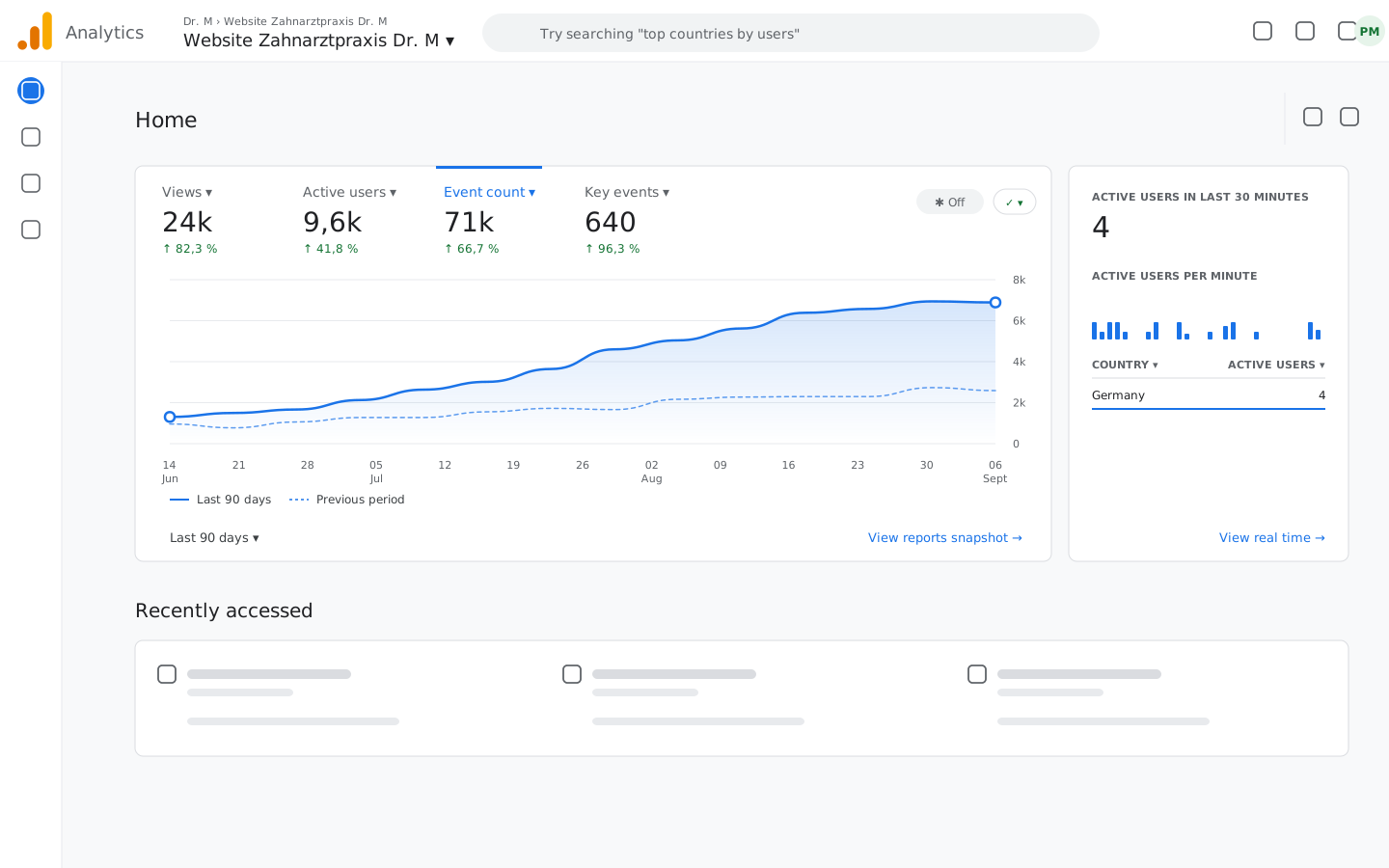
Most reports show reach, clicks and impressions: figures that look big and decide nothing. What's missing is the link to the appointment book: how many enquiries came in, how many became appointments, what did each one cost? Without that line, marketing remains a gut feeling.
What we do differently
One report a month, one page: enquiries per channel, appointments from them, cost per enquiry, and three sentences of context: what went well, what we're changing, what we're stopping. The data comes from tracking, the context from a person. A 15-minute call about it if you wish.
When you don't need reporting
To be honest, there are cases where the money goes up in smoke. Then something else comes first.
There's no campaign running yet that could be reported on.
Then it's not the report that's missing but the start. Consulting first clarifies what comes first.
First: Consulting →Enquiries come in, but nobody knows where from.
Without attribution, every report remains an estimate. Tracking first, then reporting.
First: Tracking →You want a dashboard with every metric in real time.
We can build that, but it doesn't answer any question. We recommend the one page a month and the conversation about it.
How it works
- 01
Define: the two or three figures that support a decision for your practice
Week 1
- 02
Connect: tracking, ad accounts, Google Business Profile and online booking feed into the report
Weeks 1 to 2
- 03
Monthly: one page with figures and three sentences of context, a 15-minute call if you wish
monthly
- 04
Quarterly: what stays, what goes, where to step up
every three months
Automated: data retrieval, calculations and the report itself run automatically, on time at the start of each month.
Human: the three sentences of context are written by a person who knows your practice. And the call about it isn't run by a chatbot.
What AI changes
Visits from AI answers are few but well qualified. That's why the report counts enquiries from ChatGPT, Perplexity and Google's AI as a separate channel instead of letting them disappear under “Other”. That way you can see whether the work on your visibility in AI answers is paying off.
Last checked: September 2026
What comes before, what comes after
Reporting is part of every service; it never stands alone. Before it: tracking, so the figures are right. It's the point where decisions are made about which measure stays, is expanded or is stopped.
Reporting is always included with us, not an extra.
FAQs on reporting
How much does reporting cost?
Nothing extra. It's included with every service, because we don't run any measure without a report.
Which figures are in the report?
Enquiries per channel, appointments from them and cost per enquiry. Plus three sentences of context: what went well, what we're changing, what we're stopping. More only if a decision requires it.
How often does the report arrive?
Monthly, on time at the start of each month, as one page by email. Once a quarter we review it together.
Can I read the report without marketing knowledge?
Yes, that's what it's made for: one page, three figures, three sentences. If you want to know more, you get the details in the call or in the raw data.
Do I also get the raw data?
Yes. Ad accounts, tracking and Google Business Profile belong to you, and you have access at any time. The report is the summary, not the only way in.
What happens if the figures are bad?
Then the report says so, with a proposal for what to change or stop. A report that only shows good news isn't a report.

Do you know what your marketing brought in last month?
In a free initial call we show you what a one-page report would look like for your practice.
Free · No obligation